Digital SAT · 2026–27 · 44 questions, 70 minutes

The 40 SAT Math Formulas You Must Memorize

The SAT math formula sheet built into Bluebook is geometry only: it will never show you a slope, a quadratic formula, or an exponent rule. Below is the exact official reference, then all 40 formulas it leaves out, organized by the SAT's four content domains.

⬇ Free formula sheet PDF (no email) Print view

The official reference sheet

Given on test day

Exactly what Bluebook shows you during the Math sections: 10 formulas + 2 triangles + 3 facts, all geometry. There is not a single algebra formula on it.

Circle area
A=πr2A=\pi r^2
Circle circumference
C=2πrC=2\pi r
Rectangle area
A=lwA=lw
Triangle area
A=12bhA=\tfrac{1}{2}bh
Pythagorean theorem
c2=a2+b2c^2=a^2+b^2
Rectangular prism volume
V=lwhV=lwh
Cylinder volume
V=πr2hV=\pi r^2 h
Sphere volume
V=43πr3V=\tfrac{4}{3}\pi r^3
Cone volume
V=13πr2hV=\tfrac{1}{3}\pi r^2 h
Pyramid volume
V=13lwhV=\tfrac{1}{3}lwh
45-45-90 triangle
xxx√245°45°
x:x:x2x : x : x\sqrt{2}
30-60-90 triangle
x√3x2x30°60°
x:x3:2xx : x\sqrt{3} : 2x
  • The number of degrees of arc in a circle is 360.
  • The number of radians of arc in a circle is 2π.
  • The sum of the measures in degrees of the angles of a triangle is 180.

Source: College Board digital SAT reference information (SAT Weekend Student Guide 2026-27 & official practice tests).
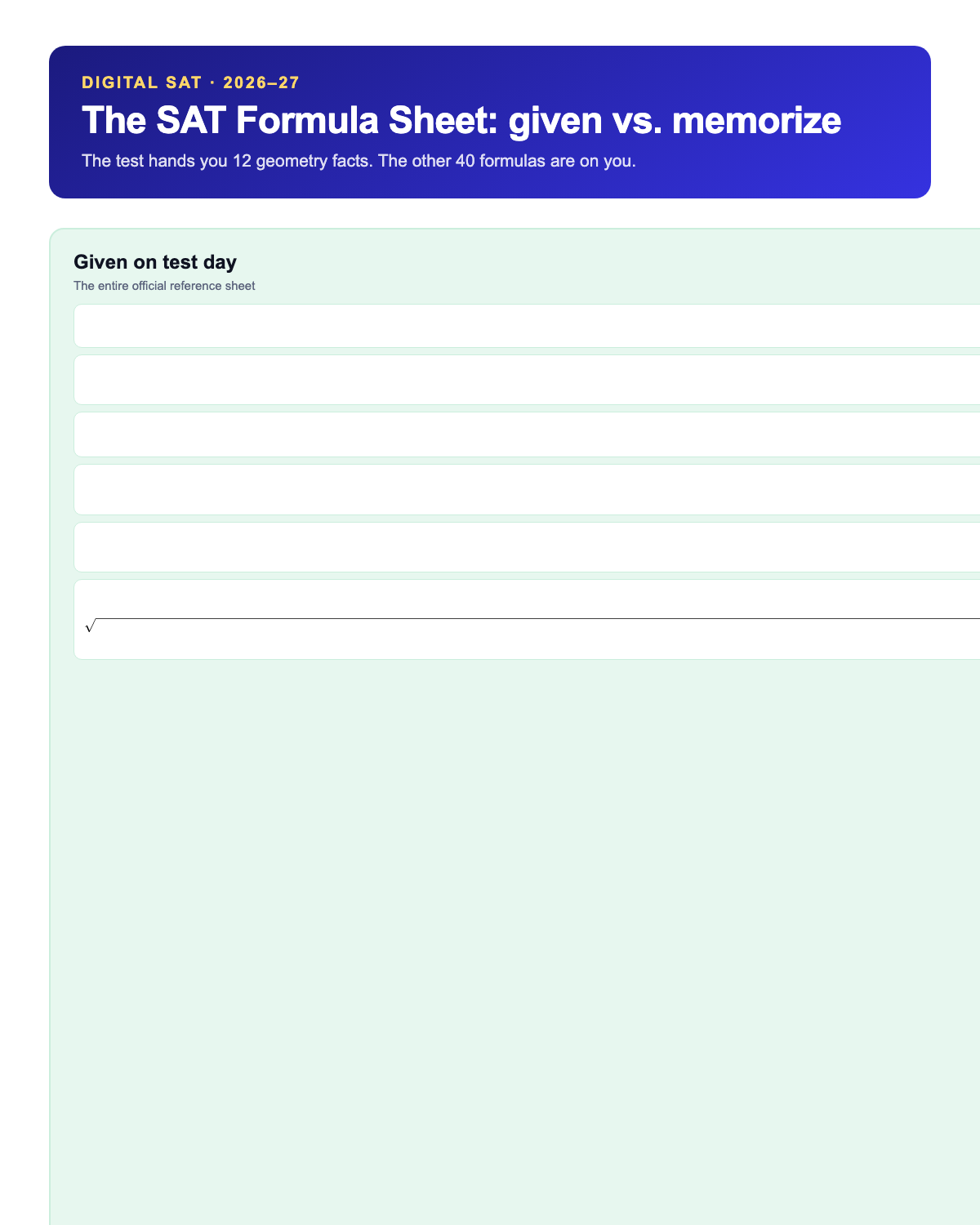
SAT formula sheet overview: the 12 geometry formulas given on test day versus the 40 math formulas to memorize, organized by the SAT's four content domains
The complete SAT formula sheet at a glance: what the reference sheet gives you (left, green) versus the 40 formulas you must memorize (right).

SAT math formulas to memorize Not on the official sheet

Core = shows up constantly. Nice to know = lower frequency, cheap insurance.

Slope formula

MemorizeCore
m=y2−y1x2−x1m=\frac{y_2-y_1}{x_2-x_1}

Two points on a line, or rows of a table of values. Nearly every linear-function question starts here.

Example
Slope through (2, 3) and (6, 11)? → m = (11−3)/(6−2) = 2

Slope-intercept form

MemorizeCore
y=mx+by=mx+b

Reading slope (m) and y-intercept (b) from an equation or a graph: the most-used line form on the test.

Example
y = 3x − 5: slope and y-intercept? → m = 3, y-intercept (0, −5)

Point-slope form

MemorizeCore
y−y1=m(x−x1)y-y_1=m\left(x-x_1\right)

You know one point and the slope and need the equation of the line.

Example
Line through (2, 3) with slope 4? → y − 3 = 4(x − 2), i.e. y = 4x − 5

Parallel lines

MemorizeCore
m1=m2m_1=m_2

"Which line is parallel to…": parallel lines have equal slopes.

Example
Line parallel to y = 2x + 7 must have slope… → m = 2 (any intercept)

Perpendicular lines

MemorizeCore
m1⋅m2=−1m_1\cdot m_2=-1

"Perpendicular" questions: slopes are negative reciprocals (flip and change sign).

Example
Slope perpendicular to y = 3x + 1? → −1/3, because 3 · (−1/3) = −1

Distance formula

MemorizeCore
d=(x2−x1)2+(y2−y1)2d=\sqrt{\left(x_2-x_1\right)^2+\left(y_2-y_1\right)^2}

Distance between two coordinate points (it's the Pythagorean theorem in disguise).

Example
Distance from (0, 0) to (3, 4)? → √(9+16) = 5

Midpoint formula

MemorizeCore
M=(x1+x22, y1+y22)M=\left(\frac{x_1+x_2}{2},\ \frac{y_1+y_2}{2}\right)

Midpoint of a segment; also works backwards (given midpoint and one endpoint, find the other).

Example
Midpoint of (2, 2) and (6, 10)? → (4, 6)

Quadratic formula

MemorizeCore
x=−b±b2−4ac2ax=\frac{-b\pm\sqrt{b^2-4ac}}{2a}

Solving ax² + bx + c = 0 when factoring isn't obvious. NOT on the official sheet: most-tested memorized formula.

Example
x² − 5x + 6 = 0? → x = (5 ± 1)/2 → x = 3 or x = 2
⚡ See the Desmos shortcut →

Vertex x-coordinate

MemorizeCore
x=−b2ax=\frac{-b}{2a}

Max/min value or vertex of y = ax² + bx + c without completing the square.

Example
Vertex x of y = x² − 4x + 3? → x = 4/2 = 2 (vertex is (2, −1))
⚡ See the Desmos shortcut →

Vertex form

MemorizeCore
y=a(x−h)2+ky=a\left(x-h\right)^2+k

Reads the vertex (h, k) directly; also how answer choices often disguise quadratics.

Example
Vertex of y = 2(x − 3)² + 1? → (3, 1)

Discriminant

MemorizeCore
b2−4acb^2-4ac

"How many real solutions?": positive → two, zero → one, negative → none.

Example
x² + 2x + 5 = 0: how many real solutions? → 4 − 20 = −16 < 0 → none

Sum & product of roots

MemorizeCore
x1+x2=−ba,x1x2=cax_1+x_2=-\frac{b}{a},\qquad x_1 x_2=\frac{c}{a}

Root questions without solving: "the sum of the solutions is…".

Example
x² − 7x + 12 = 0: sum and product of roots? → sum = 7, product = 12

Exponent rules

MemorizeCore
xaxb=xa+b,(xa)b=xab,x−a=1xa,x0=1x^a x^b=x^{a+b},\quad \left(x^a\right)^b=x^{ab},\quad x^{-a}=\tfrac{1}{x^a},\quad x^0=1

Simplifying expressions: exponent laws appear constantly in Advanced Math.

Example
x³ · x⁴ = ? → x⁷ (add exponents)

Equation of a circle

MemorizeCore
(x−h)2+(y−k)2=r2\left(x-h\right)^2+\left(y-k\right)^2=r^2

Center (h, k) and radius r in the coordinate plane. Easy to get wrong: NOT on the official sheet, and signs flip.

Example
Center and radius of (x − 3)² + (y + 2)² = 25? → center (3, −2), r = 5

Exponential growth & decay

MemorizeCore
y=a(1±r)ty=a\left(1\pm r\right)^t

Percent increase/decrease repeated over time (populations, value, interest). + for growth, − for decay.

Example
$50 growing 20% per year? → y = 50(1.2)ᵗ
⚡ See the Desmos shortcut →

Mean (average)

MemorizeCore
xˉ=Σxn,Total=xˉ⋅n\bar{x}=\frac{\Sigma x}{n},\qquad \text{Total}=\bar{x}\cdot n

Averages, plus the Total = Average × Number version for "what score do I need on the 5th test" questions.

Example
Average of 4 tests is 80. Total points? → 80 × 4 = 320

Weighted average

MemorizeCore
xˉ=ΣwixiΣwi\bar{x}=\frac{\Sigma w_i x_i}{\Sigma w_i}

Mixing groups with different averages (70% tests + 30% homework, mixed solutions, combined rates).

Example
Grade = 70% tests (avg 90) + 30% homework (avg 80)? → 0.7(90) + 0.3(80) = 87

Median, mode, range

MemorizeCore
median=middle (sorted),mode=most frequent,range=max⁡−min⁡\text{median}=\text{middle (sorted)},\quad \text{mode}=\text{most frequent},\quad \text{range}=\max-\min

"Which value of x makes the median…": sort first, always. Range needs no formula beyond max − min.

Example
Median of 3, 1, 7, 5? → sorted 1, 3, 5, 7 → median = (3+5)/2 = 4

Standard deviation (concept)

MemorizeCore
greater spread⇒greater σ\text{greater spread} \Rightarrow \text{greater } \sigma

The SAT never asks you to compute it: only which data set is more spread out. Adding a constant changes nothing; an outlier increases spread.

Example
Set A: 49, 50, 51. Set B: 0, 50, 100. Larger standard deviation? → Set B: same mean, far more spread

Percent change

MemorizeCore
%Δ=new−oldold×100\%\Delta=\frac{\text{new}-\text{old}}{\text{old}}\times 100

Percent increase/decrease: always divide by the ORIGINAL value.

Example
Price rises from 40 to 50. Percent increase? → (50−40)/40 = 25%

Probability

MemorizeCore
P=desired outcomestotal outcomesP=\frac{\text{desired outcomes}}{\text{total outcomes}}

Marbles, dice, "at random": desired over total, no replacement means the denominator shrinks.

Example
3 red and 9 blue marbles: P(red)? → 3/12 = 1/4

SOHCAHTOA

MemorizeCore
sin⁡θ=opphyp,cos⁡θ=adjhyp,tan⁡θ=oppadj\sin\theta=\frac{\text{opp}}{\text{hyp}},\quad \cos\theta=\frac{\text{adj}}{\text{hyp}},\quad \tan\theta=\frac{\text{opp}}{\text{adj}}

Right-triangle trig: one of only two trig facts you need (the other is the cofunction identity below).

Example
Right triangle, opposite 3, hypotenuse 5: sin θ? → 3/5

Cofunction identity

MemorizeCore
sin⁡x=cos⁡(90∘−x)\sin x=\cos\left(90^{\circ}-x\right)

"sin 20° = cos of what?": angles that sum to 90° pair sine with cosine. Also: sin x = cos y when x + y = 90°.

Example
sin 20° = cos ___? → cos 70°

Degrees ↔ radians

MemorizeCore
180∘=π radians180^{\circ}=\pi\ \text{radians}

Converting angle units; the sheet tells you a circle is 360° = 2π, but converting is on you.

Example
90° in radians? → π/2

Arc length

MemorizeCore
L=θ360∘⋅2πrL=\frac{\theta}{360^{\circ}}\cdot 2\pi r

Partial-circle perimeter questions: the sheet gives 2πr, you supply the fraction.

Example
60° arc of a circle with r = 6? → (60/360)(2π·6) = 2π

Sector area

MemorizeCore
A=θ360∘⋅πr2A=\frac{\theta}{360^{\circ}}\cdot \pi r^2

"Area of the shaded region" inside a circle: same fraction trick with πr².

Example
60° sector of a circle with r = 6? → (60/360)(36π) = 6π

Polygon interior angles

MemorizeCore
S=(n−2)×180∘S=\left(n-2\right)\times 180^{\circ}

Sum of interior angles of an n-gon; regular polygon single angle = S/n.

Example
Interior angles of a hexagon sum to? → (6−2)·180° = 720°

Standard form shortcut

MemorizeNice to know
Ax+By=C ⇒ m=−ABAx+By=C \ \Rightarrow\ m=-\frac{A}{B}

Quick slope from standard form without rearranging.

Example
Slope of 3x + 4y = 12? → m = −3/4

FOIL / expanding

MemorizeNice to know
(a+b)(c+d)=ac+ad+bc+bd\left(a+b\right)\left(c+d\right)=ac+ad+bc+bd

Expanding products of binomials before collecting like terms.

Example
(x + 2)(x + 3)? → x² + 5x + 6

Absolute value equations

MemorizeNice to know
∣x∣=c ⇒ x=±c\left|x\right|=c \ \Rightarrow\ x=\pm c

Two cases: positive and negative. |x| < c is a bounded interval.

Example
|x − 1| = 5? → x = 6 or x = −4

Rational exponents ↔ radicals

MemorizeNice to know
xa/b=xabx^{a/b}=\sqrt[b]{x^a}

Rewriting between root and exponent form in Advanced Math simplification.

Example
8^(2/3)? → ∛(8²) = 4

Compound interest

MemorizeNice to know
A=P(1+rn)ntA=P\left(1+\tfrac{r}{n}\right)^{nt}

Low frequency on the SAT: usually the yearly version y = a(1+r)ᵗ is enough.

Example
000 at 5% compounded annually for 2 years? → 1000(1.05)² = ,102.50

Distance–rate–time

MemorizeNice to know
d=rtd=rt

Motion and unit-rate word problems; watch unit conversions.

Example
60 mph for 2.5 hours? → 150 miles

Permutations & combinations

MemorizeNice to know
nPk=n!(n−k)!,nCk=n!k!(n−k)!{}_nP_k=\frac{n!}{\left(n-k\right)!},\qquad {}_nC_k=\frac{n!}{k!\left(n-k\right)!}

Rare, but appears in hard counting problems. Order matters → P.

Example
Ways to pick 2 letters from A, B, C (no order)? → 3 (AB, AC, BC)

Parallel line angles

MemorizeNice to know
corresponding=,co-interior=180∘\text{corresponding} =,\quad \text{co-interior} =180^{\circ}

Two parallel lines cut by a transversal: "big + small = 180°" when they're not equal.

Example
Co-interior angles 110° and ___? → 70°

Exterior angle sum

MemorizeNice to know
360∘360^{\circ}

Exterior angles of any polygon always sum to 360°.

Example
Each exterior angle of a regular hexagon? → 360/6 = 60°

Similar triangles

MemorizeNice to know
aa′=bb′=cc′\frac{a}{a'}=\frac{b}{b'}=\frac{c}{c'}

Nested/shadow triangles: corresponding sides are proportional.

Example
Similar triangles, sides 3 & 9; unknown side corresponding to 4? → 12 (scale ×3)

Direct & inverse variation

MemorizeNice to know
y=kx,y=kxy=kx,\qquad y=\frac{k}{x}

"y varies directly/inversely with x": find k from one pair, then answer.

Example
y varies directly with x; y=10 when x=2. y at x=7? → k=5 → y=35

Imaginary unit

MemorizeNice to know
i2=−1i^2=-1

Occasional complex-number arithmetic: i² = −1, i³ = −i, i⁴ = 1 (cycle of 4).

Example
i²⁰²⁶? → 2026 mod 4 = 2 → i² = −1

Surface area

MemorizeNice to know
sphere=4πr2, cyl=2πr2+2πrh, box=2(lw+lh+wh)\text{sphere}=4\pi r^2,\ \text{cyl}=2\pi r^2+2\pi rh,\ \text{box}=2\left(lw+lh+wh\right)

"Nice to know" tier: the sheet gives volumes, not surface areas.

Example
Surface area of a sphere, r = 3? → 36π